
Aquarium Book Club, Feb 2026
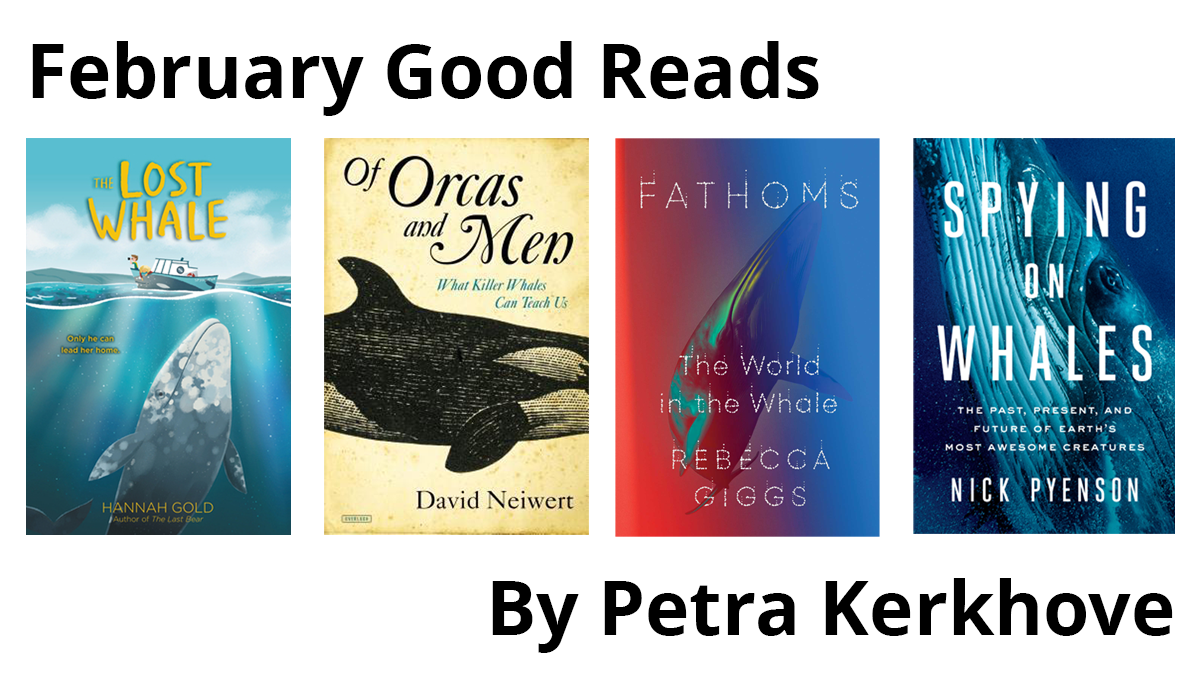
February Good Reads…Cetaceans
This month I have read several books about some of the biggest animals on the planet: cetaceans. Dolphins, whales and porpoises all belong to this group. People have always been fascinated by these animals due to their large size and economic benefits. The books I have read all explore these animals from a different perspective.
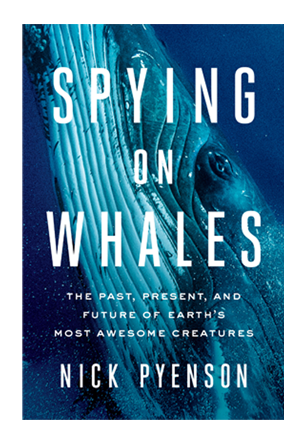
Nick Pyenson is the curator of fossil marine mammals at the Smithsonian Institution. His book Spying on Whales is a look into the evolutionary history and modern lives of cetaceans.
He brings us on a journey to see how the first whales evolved from land-living mammals. All throughout, he draws on his own experience from the archeological digs he worked on and the research he has undertaken. He illustrates how the fossil record has been helping scientists answer some of the important questions like: How did whales get so big? And, what role do cetaceans play in the marine ecosystem?
Pyenson acknowledges that cetaceans are extremely charismatic, but more importantly, they are essential to the welfare of the ocean, and therefore, to the health of the whole planet. While the book is essentially about whales themselves and their evolution, Pyenson also touches on the vulnerability of the whales in the current age, due to whaling, pollution and climate change. There is a gentle reminder that in order to preserve these beautiful creatures, we need to act now.
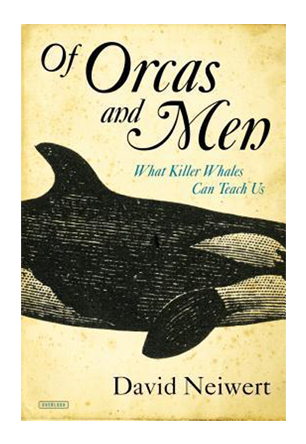
David Neiwert’s Of Orcas and Men is a book exploring the complex relationship between humans and orcas. He provides a historical timeline of human interaction with orcas and the ancient myths relating the importance of these animals for many native peoples.
It is fascinating to learn more about the power a singular species of animal has had throughout history. They are seen as a symbol of community, intelligence and they are called ‘guardians of the ocean’ by many nations. However, nowadays our position towards these animals has changed and a significant portion of the book is dedicated to the controversies surrounding captivity, addressing the moral and ethical debates ignited by the stress and shortened lifespans of orcas in tanks.
He also describes the social structures and diverse ecotypes of wild orcas, emphasizing the differences between transient mammal-eating populations and resident fish-eating populations, and he describes how every pod has their own language, culture and habits.
Neiwert’s work is a fascinating read for anyone looking to understand the orca not just as a magnificent predator, but as a lens through which to view human morality, obsession, and the responsibilities to the natural world. It counteracts the romanticization of the species, and gives an interesting account of one of the ocean’s most intelligent creatures.
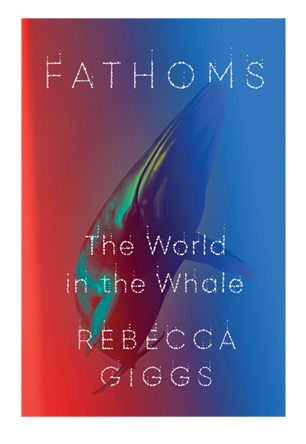
Even though the book Fathoms: The World in the Whale by Rebecca Giggs is rooted in well-researched knowledge, this is essentially a philosophical and lyrical exploration of what it means to be human.
The book starts with Giggs’ own experience of witnessing a beached whale that will eventually die on that beach. She imagines what it might be experiencing, and also details the human interaction with the whale. It is a daunting start of a book, and she does not shy away from touching upon the difficult topics of pollution and whale hunting either.
Through the senses of the whale, its anatomy and current life in the ocean, she explores our own experiences and what makes a whale unique and different to humans, yet also very alike.
Giggs writes lyrically, and her descriptions are full of sensory detail which make the book almost an immersive experience. Though rooted in her personal journey, the narrative resonates universally. It is haunting, beautiful, and helps us understand the true costs of modernity to the ocean’s giants.
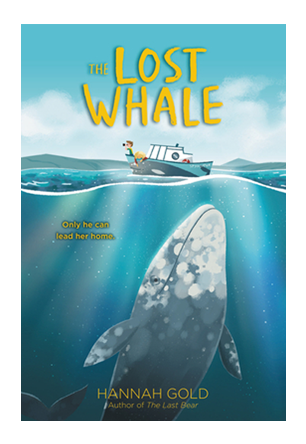
The Lost Whale by Hannah Gold is a moving children’s novel, focusing on environmental conservation, friendship, and hope.
It is the story of Rio, a young boy who is sent to live with a grandmother he barely knows. While there, he becomes obsessed with finding White Beak, a gray whale his mother was researching.
The novel is both a story of personal loss and connection, with a message about conservation. Rio’s emotional journey is mirrored by the environmental crisis facing the Pacific gray whales.
Besides the beautiful story and heartfelt execution of the novel, it is grounded in science. For example, it teaches the reader about migration patterns of the gray whale and the danger of ocean noise and pollution.
Altogether, it is a heartfelt story that shows the connection between humans and the natural world is inspiring.
MARINE MAMMAL WORKSHOP
This is a summary of a stakeholder workshop in 2025.
Next month, I will be looking at some of the fantastic women in Marine Science. Many of these women have been part of ground-breaking ideas, knowledge, and continue to inspire many of us. They might have even been the very reason we want to be ocean advocates!
I have picked the following books: Under the Sea-Wind by Rachel Carson, Spirals in Time by Helen Scales, Sharks Don’t Sink by Jasmin Graham and a children’s book about Eugenie Clark: The Shark Lady by Jess Keating.
Join me in celebrating these wonderful and inspirational women next month!
.